
Domain-Specific Small Language Models
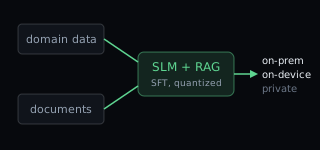
Compact language models tuned for one domain with supervised fine-tuning and grounded with retrieval — private translation and document intelligence that runs on-premise or on-device.
- Fine-tuned for the vocabulary, format, and rules of your domain, not the open internet
- Retrieval keeps answers grounded in your current documents, with sources attached
- Small enough to run where the data lives: on-premise, on a workstation, or on edge silicon
What we keep being asked
“Can a model that knows our domain run inside our walls?” Regulated buyers want translation and document intelligence that never leaves the building — and they want it without the cost curve of a general-purpose API.

What it is
A small language model — roughly 1B to 14B parameters — fine-tuned on domain text so it speaks the customer’s language: terminology, document formats, and translation conventions. A retrieval layer supplies current knowledge at answer time, so the model does not need retraining when the documents change. Typical first workloads are domain-specific translation (Korean-English technical and regulatory documents), report drafting, and question answering over private archives.
Why now
NVIDIA Research argues that small models are sufficient, more suitable, and cheaper for most agentic workloads[1]. Gartner expects task-specific small models to be adopted three times more often than general LLMs by 2027[4]. The prevailing enterprise pattern is exactly this split: fine-tuning for behavior, retrieval for knowledge[2][3]. Privacy and API cost push in the same direction — regulated customers want models that never send text outside their walls.
What UXF brings
Quantization and memory-bound inference are chip-architecture problems, and that is our home ground. We co-design the model and the deployment target together: pick the smallest model that clears your quality bar, quantize it, and report measured latency and energy per token on the hardware you will actually run — an on-premise server today, our silicon roadmap tomorrow.
Early stage: co-design engagements
How we engage
Send us your domain corpus, your quality bar, and your deployment constraint, and we return measured numbers on a candidate model. First engagements are model-and-deployment co-design projects rather than a shrink-wrapped product. Request a briefing to scope one.
Sources
- Belcak et al. (NVIDIA Research), "Small Language Models are the Future of Agentic AI", arXiv:2506.02153.
- Winder.AI, "RAG vs Fine-Tuning in 2026: A Decision Framework for LLM Teams".
- Forbes Technology Council, "Fine-Tuned SLMs: A New Operating Model for Enterprise AI", Jul 2026.
- SuperAnnotate, "Fine-tuning large language models in 2026", citing the Gartner task-specific model forecast.
Explore the rest of the stack
On-sensor AI Chip Solutions
AI processing directly at the sensor, enabling ultra-low cost and energy-efficient intelligence at the data source.
Learn more → Scalable-AIFlexible Multi-chip AI Solutions
Modular and scalable AI systems combining multiple chips, optimized for domain-specific performance and flexible deployment.
Learn more → AX-BiologyBio-AI Co-design Services
Integrated AI and hardware co-design for biological data analysis, accelerating discovery through multimodal data and lab automation.
Learn more → AI that movesPhysical AI
Collaborative R&D with commercial robotics and humanoid teams in Korea and China — low-power perception for machines that sense and act in the real world.
Learn more → Machines that reportIndustrial Sensing & PHM
Near-sensor processing of vibration, acoustic, temperature, and electrical signals for prognostics and health management — machines that report their own condition.
Learn more →