
Physical AI
Collaborative R&D with commercial robotics and humanoid teams in Korea and China — low-power perception for machines that sense and act in the real world.
- A robot is a battery-powered embedded platform; perception must fit a strict power budget
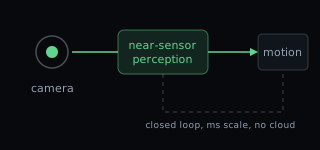
- Near-sensor vision cuts the latency and bandwidth between camera and control loop
- MOU signed with Everybot (Korea, Jul 2026); discussions opening with robot builders in China
What we keep being asked
Robot and humanoid builders need perception inside a battery budget, without a cloud round trip. Once you write down the latency and the milliwatts, the compute question stops being a software question and becomes a silicon one.
What it is
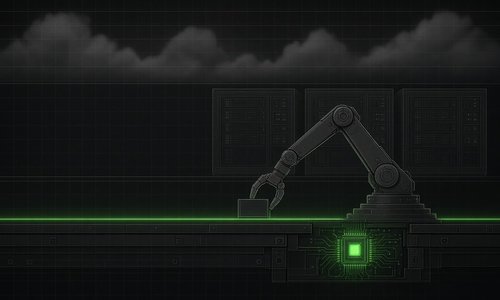
Physical AI is AI that acts through a body: humanoids, mobile robots, and automated machines. Every one of them is an embedded computing platform juggling visual perception, speech, and real-time motion control, with the compute split across robot, edge, and cloud tiers[6][15]. The perception front end — cameras and depth sensors feeding detection, tracking, and pose — is where power, latency, and cost concentrate, and it is the part that maps directly onto near-sensor silicon.
Why now
China’s humanoid output is projected to grow 94% in 2026, led by Unitree and AgiBot[7], and Beijing treats embodied AI as an industrial priority[8]. Korea is mobilizing in response: Samsung raised its Rainbow Robotics stake to 35% and created a robotics office[9][10], the major groups plan factory deployments from late 2026, and a 1-trillion-KRW government program funds on-device AI chips for robots, vehicles, and drones[5]. Both ecosystems need exactly what a near-sensor chip company sells: perception within a power budget, without a cloud round trip.
What UXF brings
We are not building a robot. We co-design the perception subsystem — sensor, silicon, and model tuned together for the robot builder’s constraint, whether that is battery life, joint-loop latency, or unit cost. Measured energy per inference on the builder’s own model is the deliverable.
In July 2026 we signed an MOU with Everybot, the KOSDAQ-listed service-robot maker, covering joint development of humanoid AI semiconductors, robot vision and sensor-fusion edge AI, and commercialization of AI-semiconductor-based robot systems[16]. Discussions with robot builders in China are opening.
MOU signed: Everybot (Korea) / China discussions opening
How we engage
Bring us the robot’s power envelope, its control-loop deadline, and the perception model you already run. We return a co-designed sensing front end with measured numbers against those three constraints. Request a briefing to start.
Sources
- DIGITIMES, "South Korea charges into the humanoid robot race as conglomerates mobilize", Aug 2026.
- EE Times, "Humanoid Robots Exit Labs: Mapping the Technical Path to Embodied AI at AW 2026".
- KraneShares, "Humanoid Robotics in 2026: The Race From Pilot to Platform".
- MERICS, "Embodied AI: China's ambitious path to transform its robotics industry".
- Samsung Newsroom, "Samsung Electronics to become largest shareholder in Rainbow Robotics".
- The Robot Report, "Samsung increases stake in Rainbow Robotics, establishes Future Robotics Office".
- EE Times Asia, "Humanoids & Robotics in 2026: Early Reality of the Physical AI Era".
- Edaily, "에브리봇, 유엑스팩토리와 맞손... 휴머노이드 AI 반도체 협력 확대", Jul 8, 2026. Also listed in our newsroom.
Explore the rest of the stack
On-sensor AI Chip Solutions
AI processing directly at the sensor, enabling ultra-low cost and energy-efficient intelligence at the data source.
Learn more → Scalable-AIFlexible Multi-chip AI Solutions
Modular and scalable AI systems combining multiple chips, optimized for domain-specific performance and flexible deployment.
Learn more → AX-BiologyBio-AI Co-design Services
Integrated AI and hardware co-design for biological data analysis, accelerating discovery through multimodal data and lab automation.
Learn more → Language, specializedDomain-Specific Small Language Models
Compact language models tuned for one domain with supervised fine-tuning and grounded with retrieval — private translation and document intelligence that runs on-premise or on-device.
Learn more → Machines that reportIndustrial Sensing & PHM
Near-sensor processing of vibration, acoustic, temperature, and electrical signals for prognostics and health management — machines that report their own condition.
Learn more →